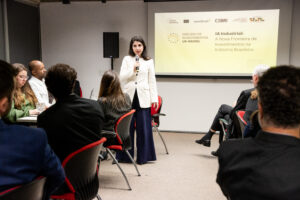
Representatives from the private sector, federal government, academia, development institutions, and European partners gathered on Thursday (14th) in São Paulo for the event AI in Industry: The New Investment Frontier in Brazilian Industry, part of the Business Dialogues series promoted under the Brazil–European Union Investment Dialogue project. Held at the headquarters of the Fernando Henrique Cardoso Foundation, the event was organized by the Brazilian Center for International Relations (CEBRI), in partnership with the European Union Delegation in Brazil and ApexBrasil.
The agenda featured thematic panels discussing next steps in bilateral cooperation in strategic areas such as digital transformation, technological infrastructure, industrial capacity building, innovation financing, and AI governance for Brazilian industry. The event took place at a particularly significant moment for the Brazil–EU agenda, marked by the entry into force of the Mercosur–EU Agreement on May 1st, President Lula’s visit to the Hannover Fair, and the anticipated signing of the Brazil–EU Digital Partnership.
The opening panel featured Sergio Fausto, Director-General of the Fernando Henrique Cardoso Foundation, who highlighted the importance of bringing together the public sector, private sector, and civil society around long-term solutions to the challenges of technological transformation in Brazil. Hussein Kalout, International Advisory Counselor at CEBRI, emphasized the intersection of artificial intelligence and industry as a fundamental matrix for the country’s development. On the European side, Johannes Klingberg, Head of the National Unit at GIZ, signaled the favorable moment for the bilateral partnership and noted that 80% of data currently collected by industry goes unused — a reality that artificial intelligence is beginning to change.
During the Keynote Speech, an overview of the Brazilian artificial intelligence ecosystem was presented by Caetano Penna, Director of Strategic Projects and International Relations at the Center for Strategic Studies and Management (CGEE), linked to the Ministry of Science, Technology and Innovation. According to the expert:
“The bottleneck in Brazilian industry is not the available technology. It exists. The technology is there, coming from Europe, the United States, Asia. It is available for licensing, implementation, and integration. The bottleneck is what we call systemic coherence,” he stated.
For Penna, systemic coherence involves the articulation between technological infrastructure, the agents that connect research and production, available capital, and the real productive cycle. Presenting the Brazilian Artificial Intelligence Plan (PBIA), with a projected investment of BRL 23 billion across five pillars, the CGEE researcher highlighted its unprecedented nature in the context of Brazilian science and technology policy, and warned of the risks of a strategy focused solely on the adoption of imported technology.
The following panel, moderated by Gabriella Seiler, Senior Fellow at CEBRI, brought together private sector representatives who shared concrete experiences of applying artificial intelligence across different productive sectors. Their accounts made clear that connectivity is a structural precondition for any industrial AI agenda, and that the expansion of 5G could add around 5% to Latin American GDP growth, provided that adequate public policies ensure the technology reaches small and medium-sized industries.
The cases presented revolved around a few central lessons. The first is that Brazilian industries often already have data but fail to give it context, which decisively limits the value extracted from technology. The second is that the value of AI lies not in the algorithm in isolation, but in its integration into the decision-making cycle and its orchestration with the company’s other operational systems. The maxim that captured this insight was straightforward: AI that does not change decisions rarely scales.
Significant structural barriers to large-scale adoption were also highlighted. The average age of machinery in Brazilian industry is 14 years, and the cost of connecting an older machine to the network runs around BRL 50,000 to 60,000 — a concrete obstacle, particularly for small and medium-sized enterprises. On the other hand, cases from the mining sector demonstrated the transformative potential: AI solutions applied to logistics reduced freight costs by 30% in one of the sector’s largest operations. The potential for including artificial intelligence as a criterion in the federal government’s Productive Development Partnerships (PDPs) was also raised, as a way to attract advanced models to Brazil through technology transfer tied to access to the SUS market.
On the financing side, the role of BNDES was highlighted: the bank has allocated approximately BRL 5 billion to AI projects since 2023 — BRL 4 billion in credit and BRL 1 billion in equity stakes — with particular attention to the heterogeneity of Brazil’s industrial fabric, which includes companies at very different stages of digital maturity. A key point raised was that many companies do not yet have structured data to work with, with information still dispersed across the routines of production-line workers.
The second part of the event was dedicated to a direct engagement dynamic, with participants divided into three groups — demand-side industries, technology providers, and financiers — for trilateral dialogues aimed at identifying concrete collaboration opportunities. The initiative is part of a systematic effort by CEBRI, the European Union, and Apex-Brasil to advance discussions of mutual interest in the Brazil–EU relationship, with a focus on tangible outcomes for the economy, innovation, and sustainable development.